Digital Signage Cost Australia 2026: Complete Pricing Guide
Last Updated: September 2026
Digital signage cost in Australia can range from a few thousand dollars for a simple one-to-three-screen setup to more than A$100,000 for a large multi-location network, outdoor LED installation or advanced video wall project. The final price depends on the display technology, screen size, brightness, pixel pitch, media player, content management software, mounting, cabling, installation complexity and ongoing support.
As a general 2026 market benchmark, small one-to-three-screen deployments are commonly budgeted at around A$2,000–A$8,000, while more complex five-to-fifteen-screen projects may reach A$15,000–A$50,000. Enterprise networks involving 20 or more screens can exceed A$100,000. These figures are market benchmarks rather than AXSS quotations.
This guide explains what actually goes into a digital signage budget, how LED and LCD costs differ, what you may pay for installation and software, and how to avoid overspending on specifications that your project does not need.
Important pricing note: All figures in this guide are indicative market estimates in Australian dollars unless stated otherwise. They are not fixed AXSS prices. Site conditions, hardware specifications, installation requirements and project scope can materially affect the final cost. GST treatment should be confirmed on your project quotation.
How Much Does Digital Signage Cost in Australia in 2026?
There is no meaningful single price for “digital signage” because a digital sign can be anything from a 43-inch commercial display mounted inside a café to a large outdoor LED screen attached to a building.
For budgeting purposes, the following ranges provide a useful starting point.
| Digital Signage Project | Indicative 2026 Budget |
|---|---|
| Single indoor commercial screen system | Around A$2,500–A$4,000 |
| 1–3 screen small-business deployment | Around A$2,000–A$8,000 |
| Basic five-screen retail/office installation | Around A$8,000–A$15,000 |
| Broader 5–15 screen deployment | Around A$15,000–A$50,000 |
| Large high-brightness commercial display | Can exceed A$5,000 for the display alone |
| Indoor direct-view LED | From around A$2,000/m² at entry market level before controllers, structure and installation |
| Small outdoor LED installation | Around A$15,000–A$35,000 for some 3 m² benchmark projects |
| 20+ screen enterprise network | A$100,000+ |
| Transparent LED display | Custom quote |
| Complex LED video wall | Custom quote |
Published Australian market guides currently report approximately A$2,000–A$8,000 for small one-to-three-screen projects and A$15,000–A$50,000 for five-to-fifteen-screen deployments. A separate Australian installation benchmark places a standard 43–55-inch commercial single-screen system with mounting, player and basic configuration at approximately A$2,500–A$4,000.
The most important point is that the screen price is only one part of the investment.
A complete digital signage system can include:
- Commercial display or LED modules
- Media player
- Content management system
- Mounting hardware
- Video processor
- Electrical work
- Data/network cabling
- Structural work
- Installation
- Commissioning and calibration
- Content creation
- Staff training
- Remote monitoring
- Maintenance and technical support
That is why two projects using apparently similar screen sizes can have very different final prices.
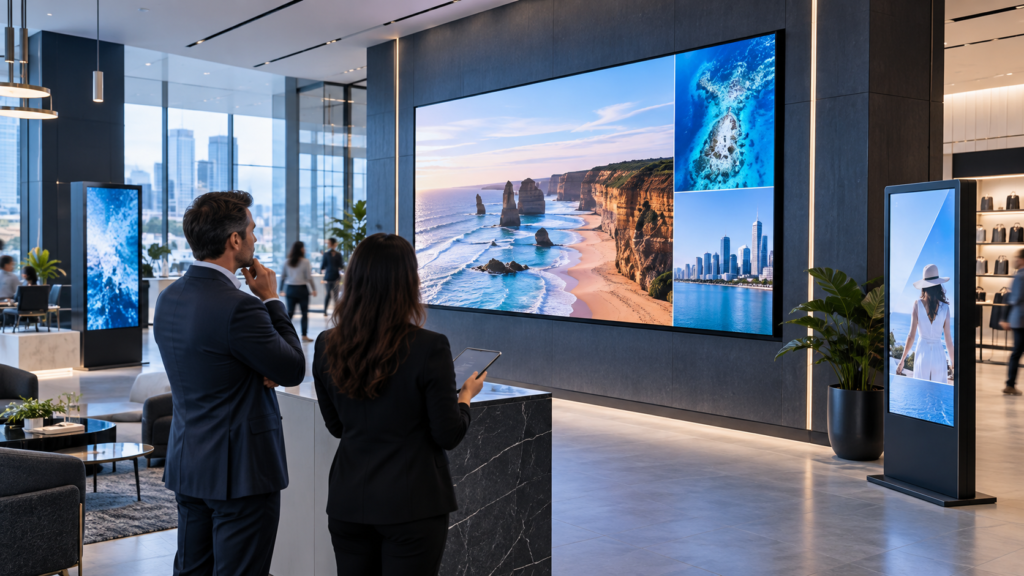
What Is Included in the Cost of a Digital Signage System?
Commercial Digital Signage Displays
The display is usually one of the largest hardware costs in an LCD-based system.
Commercial displays are designed differently from typical consumer televisions. Depending on the model, they may be designed for longer operating hours, portrait installation, higher brightness, remote management and continuous use in commercial environments.
Pricing is influenced by:
- Screen size
- LCD or LED technology
- Resolution
- Brightness
- 16/7 or 24/7 operating rating
- Indoor or outdoor use
- Anti-glare requirements
- Commercial warranty
- Integrated signage platform
- Touch functionality
A screen positioned deep inside a controlled-light office has very different requirements from a screen installed directly behind a sun-facing retail window.
Paying for extreme brightness where it is not required wastes budget. Using an under-specified display in a bright environment can make the screen difficult to see.
Digital Signage Media Players
A media player is the device responsible for delivering content to the screen.
Some commercial signage displays include an integrated operating system or signage player. Others require an external device.
An external media player may be required when the system needs:
- Advanced content scheduling
- Multiple content zones
- Remote monitoring
- Web applications
- Dashboard integration
- Live data
- Interactive functionality
- High-resolution playback
- Video-wall synchronisation
- Specialist CMS software
A basic Australian market benchmark places dedicated media players at roughly A$250–A$600, although enterprise-grade or specialist hardware can cost significantly more.
Digital Signage Software and CMS
A content management system, or CMS, allows businesses to upload, schedule and remotely control content across one or hundreds of screens.
Digital signage software may be priced:
- Per screen per month
- Per media player
- Per location
- Per feature tier
- Annually
- On a multi-year licence
- Through custom enterprise pricing
Published Australian products demonstrate how widely the model can vary. SPARC, for example, has advertised SaaS pricing beginning around A$15 per screen per month, while Fusion Signage publishes multi-year licences and states that its listed pricing is in AUD excluding GST.
Your CMS requirements become more expensive when you need features such as:
- Multiple locations
- User permissions
- Approval workflows
- Proof-of-play reporting
- Real-time monitoring
- API integrations
- Analytics
- Emergency messaging
- SSO
- Advanced scheduling
- Interactive applications
For a single local shop, a basic CMS may be sufficient.
For a national retail chain managing hundreds of screens, software architecture and support become a much more important part of the total cost.
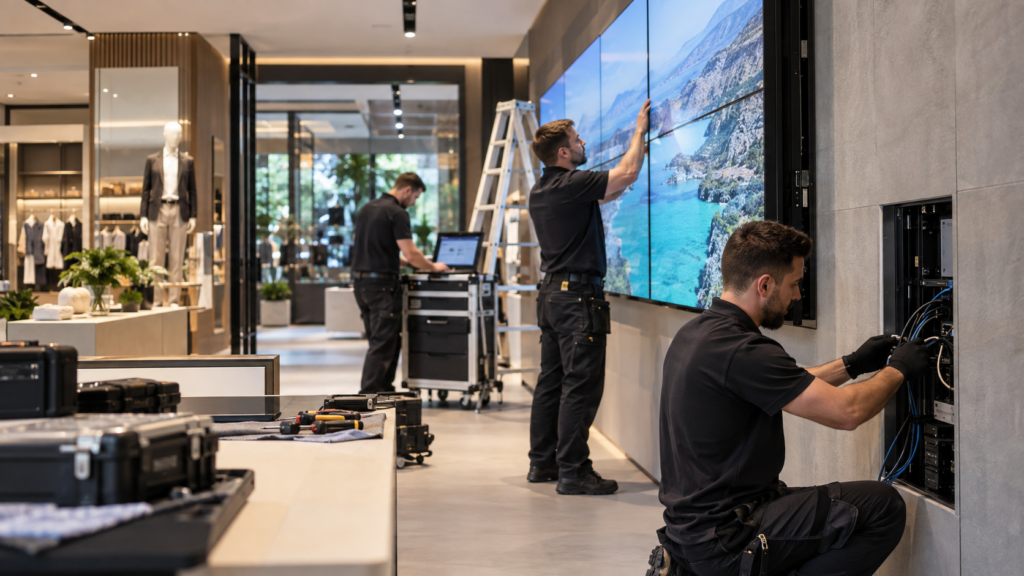
Mounting Hardware and Cabling
The screen needs to be physically and electrically integrated into the space.
Costs can include:
- Fixed wall mounts
- Full-motion brackets
- Ceiling mounts
- Floor stands
- Custom frames
- Equipment cabinets
- Power outlets
- Ethernet
- Fibre
- HDMI or signal distribution
- Cable concealment
A basic fixed wall mount may be relatively inexpensive, while a custom structure supporting a large-format LED video wall can become a significant engineering component of the project.
Professional Installation
Digital signage installation cost depends heavily on access, screen weight, mounting location and system complexity.
Australian market benchmarks place straightforward wall-mounting labour at roughly A$200–A$500 per screen. Complex LED walls, outdoor installations and projects requiring structural work, electrical upgrades or specialised access can add thousands of dollars.
Installation is not simply a matter of hanging a screen on a wall.
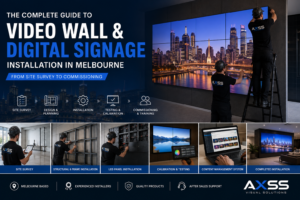
A professional deployment can involve:
- Site survey
- Measurements
- Viewing-distance assessment
- Structural assessment
- Electrical planning
- Network planning
- Mounting
- Screen alignment
- Video processing
- Calibration
- CMS configuration
- Testing
- Training
- Handover
The more complex the environment, the more important these steps become.
Content Creation
Hardware without appropriate content provides limited value.
Content budgets can include:
- Static promotional designs
- Digital menu templates
- Motion graphics
- Brand animations
- Promotional videos
- Product feeds
- Data dashboards
- Interactive applications
Published Australian market benchmarks suggest relatively simple static graphics may cost roughly A$50–A$200 per design, while custom animation and video can move into hundreds or thousands of dollars depending on production requirements.
Businesses that already have an internal design team may significantly reduce this part of their ongoing cost.
Support and Maintenance
Digital signage should also be considered as an operating system rather than a one-time hardware purchase.
Ongoing support may include:
- Remote device monitoring
- Software updates
- Fault diagnosis
- Replacement components
- On-site servicing
- LED module replacement
- Preventive maintenance
- Content support
- Network troubleshooting
For business-critical installations, the availability and response time of technical support can be more important than saving a small amount on the initial purchase price.
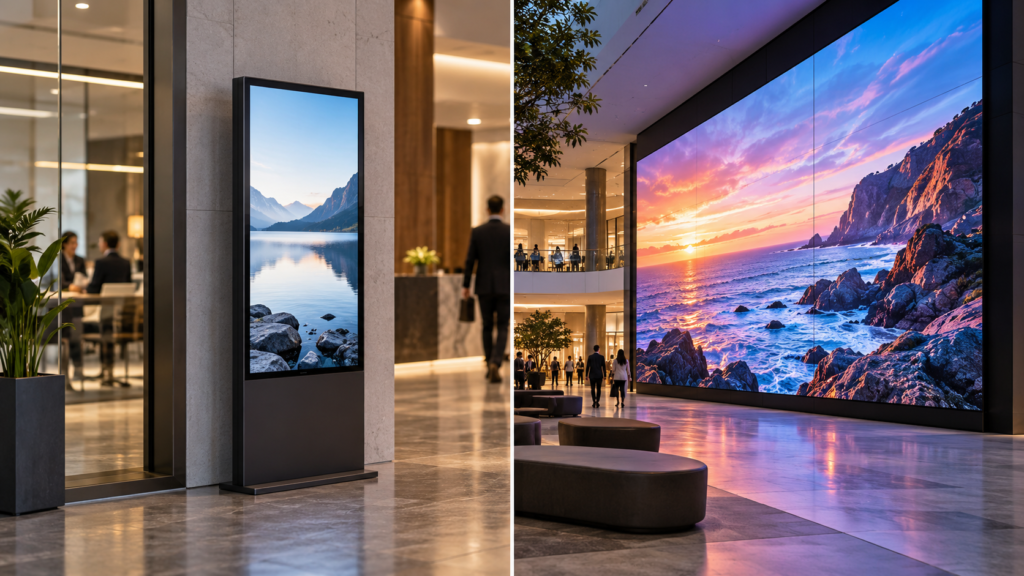
Digital Signage Price by Display Type
Indoor Digital Signage Cost
Standard commercial LCD signage is usually one of the most cost-effective ways to deploy professional digital signage.
Best for: retail stores, receptions, offices, clinics, gyms, cafés and internal communications.
Major cost drivers: screen size, brightness, operating hours, media player and installation.
For businesses needing only one or several standard-sized screens, LCD commercial displays can provide a lower entry cost than custom direct-view LED.
High-Brightness Window Display Cost
Retail windows create a difficult viewing environment because the display competes with daylight.
High-brightness commercial screens therefore cost more than typical indoor displays.
Large high-brightness commercial displays can exceed A$5,000 for hardware alone before installation and infrastructure are considered.
Best for: shop windows, shopping centres, real estate offices, dealerships and street-facing retail.
Major cost drivers: brightness, display size, sunlight exposure, cooling and operating hours.
Digital Menu Board Cost
Digital menu boards commonly use two, three or more commercial LCD screens installed side by side.
Best for: restaurants, cafés, QSRs, food courts and hospitality venues.
The system cost depends on:
- Number of screens
- Screen dimensions
- Menu design
- CMS
- POS integration
- Installation
- Content update requirements
For a small menu-board deployment, the general one-to-three-screen budget range provides a useful initial reference, but an accurate quote should be built around the actual venue.
LED Video Wall Cost
LED video walls have one of the widest possible pricing ranges.
Unlike an LCD screen with fixed dimensions, direct-view LED is normally designed by area and pixel pitch.
The price may include:
- LED cabinets/modules
- Receiving cards
- Sending controller
- Video processor
- Mounting structure
- Power distribution
- Cabling
- Calibration
- Spare modules
- Installation
- Commissioning
Published Australian market guidance currently places some entry indoor LED panel pricing from approximately A$2,000 per square metre, but this should never be interpreted as the cost of a finished LED video wall. Controllers, structure, processing, installation and the selected pixel pitch can change the project total substantially.
AXSS provides custom LED video wall systems for commercial, retail and public environments and notes that the technology can be configured to different sizes and applications.
Outdoor LED Screen Cost
Outdoor LED requires significantly different engineering from indoor signage.
The system may need to handle:
- Rain
- Dust
- Heat
- Wind
- Direct sunlight
- Structural loads
- Drainage
- Ventilation
- Maintenance access
AXSS currently specifies outdoor LED options with brightness levels of up to 10,000 nits for applications where sunlight visibility is required.
A published Australian 2026 installation guide provides an example budget of approximately A$15,000–A$35,000 for a 3 m² outdoor LED installation, but actual outdoor projects can vary dramatically based on size, structure, location, approvals and pixel pitch.
Transparent LED Display Cost
Transparent LED should generally be treated as a custom-project product rather than a standard screen purchase.
The price depends on:
- Surface dimensions
- Transparency requirement
- Pixel pitch
- Brightness
- Glass structure
- Mounting method
- Controller
- Electrical infrastructure
AXSS uses transparent LED solutions for applications including retail windows, showrooms, museums, galleries and glass façades.
Interactive Digital Signage and Kiosk Cost
Interactive digital signage adds another layer of hardware and software.
Additional costs may include:
- Touchscreen technology
- Kiosk enclosure
- Computer or media player
- Interactive software
- Web application
- API integration
- POS integration
- Analytics
- Accessibility features
For this reason, interactive projects should generally be quoted according to the application rather than by screen size alone.
Digital Signage Cost by Screen Size
Screen dimensions are one of the easiest specifications to understand, but they should not be considered in isolation.
Current Australian installation benchmarks provide the following display-only ranges:
| Screen Size | Indicative Commercial Display Hardware |
|---|---|
| 43-inch | A$1,200–A$2,200 |
| 55-inch | A$1,800–A$3,500 |
| 65-inch | Project-specific |
| 75-inch | A$3,500–A$6,500 |
| Custom LED | Priced by area, pixel pitch and specification |
These are indicative third-party market benchmarks rather than AXSS product prices.
43-Inch Digital Signage Cost
A 43-inch commercial screen can work well where viewing distance is relatively short and wall space is limited.
Typical applications include:
- Reception desks
- Small retail displays
- Queue information
- Internal communications
- Small menu boards
55-Inch Digital Signage Cost
The 55-inch category is one of the most versatile sizes for commercial use.
It provides significantly more visual impact than smaller screens without reaching the installation and space requirements of very large displays.
65-Inch Digital Signage Cost
A 65-inch screen is useful for larger retail areas, boardrooms, showrooms and reception spaces.
Brightness, manufacturer, duty cycle and mounting requirements may influence the final price as much as screen size.
75-Inch and Large-Format Display Cost
Large-format LCD screens provide considerable impact but are heavier, harder to handle and more demanding to install.
Access conditions therefore become increasingly important.
Moving a 75-inch commercial display into a ground-floor retail shop is very different from installing one several metres above floor level in an operating shopping centre.
Custom LED Screen Pricing
Custom LED should not be selected by physical dimensions alone.
Pixel pitch determines how many physical LEDs are required within a given area.
A finer pitch contains more pixels per square metre and normally costs more.
AXSS’s technical guidance explains that finer pixel pitches require more LED packages, driver components, processing capacity and manufacturing precision, which is why selecting the smallest available pitch is not automatically the best financial decision.
What Factors Affect Digital Signage Pricing?
Screen Size
Larger commercial LCD displays generally cost more and may require stronger brackets, additional installers and more complex access.
With LED, both physical area and pixel density matter.
Brightness
Higher brightness usually increases hardware cost and can also influence power consumption.
The correct brightness depends on ambient light.
An indoor screen does not need the same output as an outdoor screen facing direct sunlight.
Resolution
Higher resolution can be important when viewers are close to the screen or the content contains detailed text, dashboards or technical information.
For direct-view LED, native resolution is determined by the physical screen dimensions and pixel pitch.
Pixel Pitch
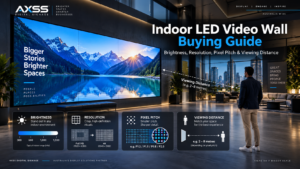
Pixel pitch is one of the biggest cost drivers in an LED wall.
A smaller pitch means more pixels in the same area.
AXSS recommends choosing pitch according to real viewing conditions rather than automatically specifying the finest possible product.
Indoor vs Outdoor Installation
Outdoor installations usually require higher brightness, weather resistance and more substantial engineering.
These requirements can significantly increase project cost.
Viewing Distance
The audience should determine the specification.
If viewers remain eight or ten metres away, an extremely fine pixel pitch may provide little visible improvement while increasing the price.
AXSS’s video wall installation guidance specifically notes that unnecessary fine-pitch specification can add considerable cost without creating a meaningful benefit at longer viewing distances.
Mounting Location and Access
Installation costs can rise when technicians require:
- Elevated work platforms
- Scaffolding
- After-hours access
- Traffic management
- Ceiling reinforcement
- Custom structural steelwork
This is why a site survey should happen before the final equipment specification.
Electrical and Network Requirements
Existing infrastructure can dramatically change installation cost.
A project may require:
- New power outlets
- Dedicated circuits
- Ethernet
- Wi-Fi upgrades
- Fibre
- Equipment racks
- Surge protection
- Network configuration
Planning these requirements before installation helps prevent expensive last-minute changes.
Content Management Software
Software cost depends on both screen count and required capability.
A local café and a national retail group do not require the same CMS architecture.
Number of Screens and Locations
Larger projects may gain efficiencies through standardised hardware and repeatable installation, but multi-location projects introduce other expenses including logistics, remote monitoring and support.
Installation Complexity
LED alignment, calibration and processor configuration require more specialist work than mounting one standard commercial LCD.
Warranty and Technical Support
Warranty duration and after-sales support should be evaluated alongside purchase price.
At the time of this September 2026 update, AXSS advertises a three-year warranty across its main website.
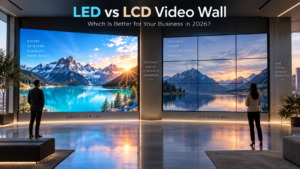
LCD vs LED Digital Signage Cost
| Factor | Commercial LCD | Direct-View LED |
|---|---|---|
| Initial cost | Usually lower | Usually higher |
| Screen dimensions | Fixed standard sizes | Highly customisable |
| Brightness | Standard to high-brightness models | Very high brightness available |
| Seamless image | Single screen is seamless; tiled walls may show bezels | Seamless modular canvas |
| Close viewing | Excellent at standard 4K resolutions | Depends heavily on pixel pitch |
| Outdoor use | Specialist outdoor products required | Strong outdoor options available |
| Maintenance | Replace display as a complete unit | Individual modules/components may be serviced |
| Best applications | Standard signage, menus, offices, retail | Large walls, architecture, high-impact signage |
The correct technology depends on the viewing distance, available space, content, brightness requirements and project budget.
A standard commercial LCD may deliver a better financial outcome for a small indoor installation.
A large custom LED canvas can make more sense where seamless scale, brightness or architectural integration is essential.
Consumer TV vs Commercial Digital Signage: Which Costs Less?
A normal television will almost always look attractive when only the purchase price is considered.
But purchase price is not total cost of ownership.
Before using a consumer TV for commercial signage, compare:
- Rated operating hours
- Brightness
- Portrait support
- Heat management
- Remote device control
- Automatic recovery
- Commercial warranty conditions
- Long-term reliability
A consumer smart TV can still make sense for low-budget or non-critical applications.
AXSS already covers this question in detail in Turn Smart TV into Digital Signage: Pros, Cons, and Best Use Cases, including situations where a lower-cost smart TV installation may be appropriate and where commercial hardware becomes the better option.
The cheapest screen on day one is not necessarily the cheapest screen over five years.
Digital Signage Installation Cost in Australia
Installation deserves its own budget rather than being hidden inside the hardware price.
Simple Wall-Mounted Installation
Market benchmarks suggest roughly A$200–A$500 per screen for straightforward mounting labour and basic cabling.
Ceiling and Freestanding Installations
These systems may require specialist mounts and greater attention to load, stability and cable routing.
Multi-Screen Installations
When several displays are installed together, additional time may be required for alignment, network configuration, CMS setup and content testing.
LED Video Wall Installation
LED video walls require:
- Precise cabinet alignment
- Structural mounting
- Power distribution
- Data distribution
- Processor configuration
- Colour calibration
- Testing
The structure must often be designed specifically for the display.
Outdoor LED Screen Installation
Outdoor installations can require structural engineering, weatherproof electrical infrastructure, access equipment and compliance planning.
Electrical and Structural Costs
Never assume the existing wall, ceiling, switchboard or network is ready for the installation.
A professional site assessment can identify these costs before equipment is ordered.
How Much Does Digital Signage Software Cost?
Software is often one of the main recurring expenses.
Basic CMS
Basic platforms may provide:
- Media upload
- Playlists
- Basic scheduling
- Screen management
Australian products currently demonstrate entry pricing from around A$15 per screen per month, depending on provider and plan.
Multi-Screen CMS
Growing businesses may need:
- Groups
- Locations
- Advanced scheduling
- Templates
- User permissions
- Synchronisation
- Remote monitoring
Enterprise Digital Signage Software
Enterprise networks may add:
- SSO
- APIs
- Audit logs
- Advanced analytics
- Proof of play
- Dedicated support
- Service-level agreements
Pricing is frequently customised.
Cloud vs On-Premise CMS
Cloud systems can reduce the need to maintain internal signage servers.
On-premise solutions may still be appropriate when the organisation has particular compliance, network or infrastructure requirements.
Remote Content Management
Remote management becomes increasingly valuable as the network grows.
Being able to update 50 locations centrally is very different from sending staff to individual sites with USB drives.
Digital Signage Cost for Different Australian Businesses
Retail Stores
Retailers may use window displays, promotional screens, product displays and large LED feature walls.
Brightness and installation position are major cost drivers.
Restaurants and Cafés
Restaurants commonly use two or three commercial screens as digital menu boards.
The ability to schedule breakfast, lunch, dinner and promotional menus can be more important than advanced display hardware.
Corporate Offices
Corporate deployments may include reception displays, meeting-room screens, dashboards and large lobby LED walls.
Resolution becomes especially important where the display shows text or data.
Medical Centres
Typical applications include waiting-room information, queue systems, educational material and wayfinding.
Gyms and Fitness Centres
Gyms can use screens for class schedules, promotions, member communication and digital advertising.
Schools and Universities
Education environments may require campus information, event communication, emergency messaging and wayfinding across multiple buildings.
Car Dealerships
High-brightness window screens, showroom displays, vehicle promotions and large-format LED installations can all be relevant.
Shopping Centres
Large-scale shopping centre projects may include directory kiosks, LED walls, advertising screens and outdoor displays.
Hotels and Hospitality
Common applications include digital menus, lobby screens, conference information, wayfinding and promotional content.
Multi-Location Businesses
For multi-location businesses, hardware consistency and remote management should be considered from the beginning.
Buying five cheap standalone systems may create a more expensive operational problem when the network grows to fifty locations.
Practical Digital Signage Budget Examples
The following examples are illustrative market-budget models, not AXSS quotations.
Example 1: One-Screen Retail Store
A straightforward 43–55-inch commercial screen system may include:
- Commercial display
- Wall mount
- Media player
- CMS
- Basic installation
- Initial configuration
Indicative benchmark: approximately A$2,500–A$4,000 for a straightforward deployment.
Example 2: Three-Screen Café Menu Board
Typical requirements:
- Three commercial screens
- Three mounts
- Media player architecture
- CMS
- Menu templates
- Installation and alignment
This would generally sit within the broader one-to-three-screen project category, where Australian market guidance currently places typical initial investment at approximately A$2,000–A$8,000, depending on specification.
Example 3: Five-Screen Corporate Office
A basic five-screen office installation has been benchmarked at approximately A$8,000–A$15,000 by one Australian installation provider.
More sophisticated five-to-fifteen-screen projects involving higher-end displays, integration and advanced software may move into the A$15,000–A$50,000 range.
Example 4: Large LED Video Wall
A large LED video wall cannot be accurately budgeted from screen dimensions alone.
Pricing must account for:
- Display area
- Pixel pitch
- Native resolution
- Processor
- Structure
- Electrical requirements
- Installation
- Calibration
- Maintenance access
A site-specific quotation is the correct way to budget the project.
Example 5: Multi-Location Retail Network
For networks involving 20 or more screens, published Australian market guidance indicates that total initial investment can exceed A$100,000, particularly when the network combines commercial displays, LED, analytics, integration and managed services.
Upfront Cost vs Total Cost of Ownership
Purchase price should not be the only number used to compare systems.
A useful calculation is:
3-Year TCO = Hardware + Installation + CMS + Content + Maintenance + Support + Energy
Consider two systems.
System A may have cheaper screens but require frequent replacement, manual content management and costly service calls.
System B may cost more initially but provide remote management, better reliability and a longer commercial warranty.
After three years, System B may have the lower total cost.
TCO analysis becomes especially important for multi-location signage where small recurring expenses are multiplied across dozens or hundreds of screens.
How to Reduce Digital Signage Costs Without Buying the Wrong System
Choose Pixel Pitch Based on Viewing Distance
Do not automatically buy the finest pixel pitch available.
If viewers will never stand close enough to see the additional detail, you may be paying for pixels that provide no meaningful visual benefit.
Avoid Paying for Unnecessary Brightness
More nits are not automatically better.
Specify brightness according to ambient lighting.
Use the Right Screen Size
The largest screen that fits the wall is not necessarily the best screen for the audience.
Viewing distance and content should determine size.
Plan Cabling Before Installation
Power and data planning before equipment arrives can prevent expensive rework.
Choose Scalable CMS Software
If expansion is likely, choose a system that can manage additional screens and locations without rebuilding the whole network.
Consider Long-Term Maintenance
Ask how the display will be serviced before it is installed.
For large LED walls, front-access versus rear-access maintenance can significantly influence installation design.
The cheapest digital signage system is not always the lowest-cost digital signage system.
Is Digital Signage Worth the Cost?
The business case depends on what the display replaces or enables.
Potential financial and operational benefits include:
- Faster campaign changes
- Reduced printing and reprinting
- Central control across multiple locations
- Dynamic promotions
- Automated menu updates
- Internal communication
- Advertising opportunities
- Faster reaction to stock or pricing changes
The value should be measured against a defined objective.
How to Calculate Digital Signage ROI
A simple starting formula is:
ROI = (Financial Benefit − Total Cost) ÷ Total Cost × 100
For example, if a signage system costs A$20,000 over a defined period and produces or saves A$30,000 in measurable value:
ROI = (A$30,000 − A$20,000) ÷ A$20,000 × 100 = 50%
Financial benefit might include additional gross profit, avoided printing costs, advertising revenue or labour savings.
Avoid claiming ROI without establishing how the benefit will actually be measured.
Digital Signage Costs in Sydney, Melbourne and Other Australian Cities
Digital signage hardware does not necessarily change dramatically between Sydney, Melbourne, Brisbane, Perth, Adelaide or Canberra.
Installation costs can.
Important variables include:
- Technician availability
- Travel
- Site access
- Parking
- Building restrictions
- Shopping-centre access
- After-hours work
- Structural requirements
- Elevated access
AXSS currently advertises free installation in Sydney and Melbourne, together with free measurement and consultation in Sydney and Melbourne, a three-year warranty and a price-match guarantee. Businesses should confirm that these offers remain applicable to their particular project when requesting a quotation.
How to Get an Accurate Digital Signage Quote
The fastest way to receive a useful quotation is to provide the technical information the signage company actually needs.
Before requesting a quote, prepare:
- Number of screens
- Preferred screen dimensions
- Indoor or outdoor location
- Installation address
- Minimum viewing distance
- Typical viewing distance
- Maximum viewing distance
- Expected operating hours
- Ambient-light conditions
- Wall, floor or ceiling installation
- Content requirements
- CMS requirements
- Number of locations
- Required integrations
- Project timeline
For an LED wall, also provide approximate available width and height.
Photos of the installation location are useful, but a professional site assessment may still be necessary before the final specification is approved.
Request a Free Digital Signage Site Assessment & Quote
AXSS provides custom digital signage display, LED video wall, outdoor LED and transparent LED solutions for businesses across Australia, with design, installation, remote content management and ongoing support.
A properly scoped quote should help you understand not only what the screen costs, but what the complete working system will cost to install, operate and maintain.
Frequently Asked Questions About Digital Signage Cost
How much does digital signage cost in Australia?
A small one-to-three-screen digital signage project may cost approximately A$2,000–A$8,000, while five-to-fifteen-screen deployments can reach approximately A$15,000–A$50,000. Large 20+ screen enterprise systems may exceed A$100,000. These are market benchmarks rather than fixed AXSS prices.
How much does digital signage cost per screen?
A complete standard single-screen commercial signage system can cost roughly A$2,500–A$4,000 in current Australian market benchmarks when the screen, mount, player, installation and basic configuration are included. Complex applications cost more.
How much does a 55-inch digital signage screen cost?
One current Australian benchmark places 55-inch commercial display hardware at approximately A$1,800–A$3,500, before software and more complex infrastructure.
How much does digital signage installation cost?
Straightforward screen mounting is commonly benchmarked around A$200–A$500 per screen. Video walls, outdoor LED and complex structural installations can cost several thousand dollars or more.
How much does digital signage software cost per month?
Australian software pricing varies considerably. Entry products can start around A$15 per screen per month, while advanced and enterprise systems may use higher per-screen rates or custom contracts.
Is LED signage more expensive than LCD digital signage?
Usually, particularly for fine-pitch direct-view LED. However, LED provides custom dimensions, strong brightness and seamless large-format display surfaces that LCD cannot always provide.
What is the cheapest digital signage option?
For low-duty indoor applications, an existing smart TV paired with compatible signage software can provide a low-cost entry point. Commercial environments requiring long operating hours, high brightness or business-critical reliability should consider commercial-grade hardware.
Can I use a normal TV for digital signage?
Yes, in some applications. However, operating hours, brightness, mounting orientation, remote management and warranty conditions should be checked before using a consumer TV in a commercial environment.
How much does an LED video wall cost in Australia?
There is no reliable fixed price. Physical area, pixel pitch, controller, native resolution, structure and installation all affect the result. A professional site assessment is recommended before budgeting a large LED wall.
How much does an outdoor LED screen cost?
A 2026 Australian market example places some small 3 m² outdoor installations around A$15,000–A$35,000, but larger or structurally complex projects can cost considerably more.
What ongoing costs does digital signage have?
Ongoing expenses can include CMS subscriptions, content creation, remote monitoring, maintenance, technical support, replacement components and electricity.
Does digital signage require a monthly subscription?
Not always. Some CMS products charge monthly, while others use annual or multi-year licences. Enterprise software may use custom contracts.
Does the price include installation?
It depends on the supplier and proposal. Hardware-only prices should never be assumed to include mounting, electrical work, commissioning or installation.
Does digital signage pricing include GST?
Not always. Some Australian providers publish prices excluding GST while others quote differently. Confirm whether GST is included before comparing proposals.
How long does commercial digital signage last?
Service life depends on hardware quality, operating hours, temperature, environment, maintenance and technology. For long-term planning, evaluate rated operating hours, warranty and replacement strategy rather than relying on one generic lifespan figure.
Final Thoughts: Budget for the System, Not Just the Screen
The most common digital signage pricing mistake is comparing only hardware.
A A$2,000 screen does not mean you have a A$2,000 digital signage system.
The real budget may also need to cover installation, mounting, CMS software, media players, content, networking, electrical work, support and future maintenance.
The best way to control digital signage cost is therefore not to buy the cheapest equipment.
It is to specify the system correctly.
Choose screen size according to viewing distance. Choose brightness according to the environment. Choose pixel pitch according to what the audience can actually see. Plan power and network infrastructure before installation. Select software that can scale with the business.
For LED walls in particular, AXSS recommends evaluating brightness, native resolution, pixel pitch and viewing distance as one connected system rather than treating each specification independently.
With the right planning, digital signage can move from being a screen purchase to a long-term communication platform built around the actual needs of the business.