LED vs LCD Video Wall: Which Is Better for Your Business in 2026?
Choosing between an LED and LCD video wall is not simply a matter of deciding which display technology is newer.
The right choice depends on how large the display needs to be, how close people will stand to it, the type of content being shown, ambient light levels, whether visible panel seams are acceptable, installation conditions and the total budget over the life of the system.
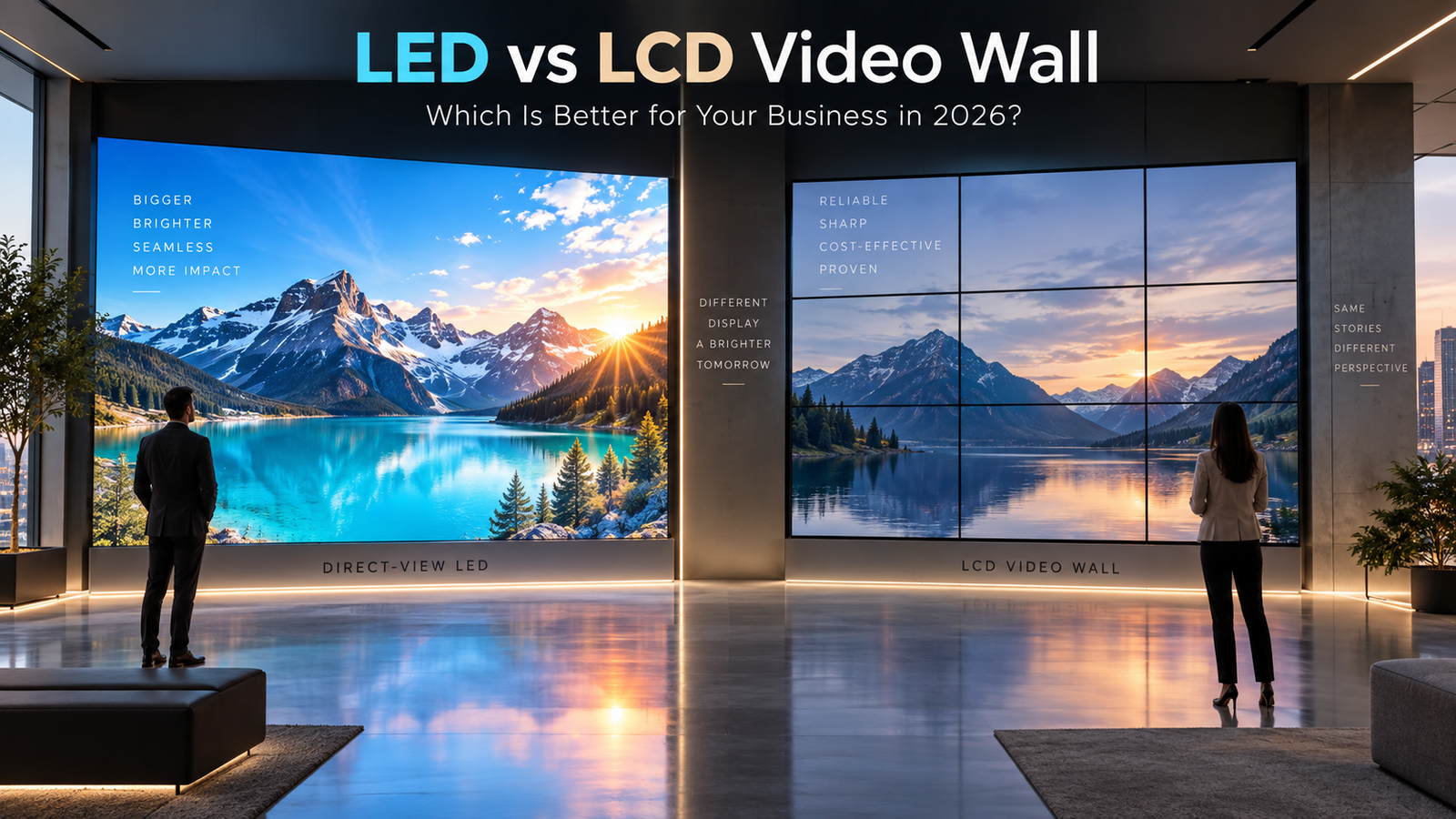
For many large-format commercial applications, Direct-View LED (DVLED) has a significant advantage because it can create a virtually seamless display in flexible sizes and shapes, with strong brightness and excellent visibility.
However, LCD video walls are far from obsolete.
For applications where viewers sit very close to the screen, where high pixel density is important, where the display follows a conventional rectangular layout, or where initial budget is a major consideration, a commercial LCD video wall can still be the more practical solution.
This guide compares LED vs LCD video walls across image quality, resolution, pixel pitch, viewing distance, brightness, cost, maintenance, lifespan, installation requirements and real-world applications to help you make a better investment decision.
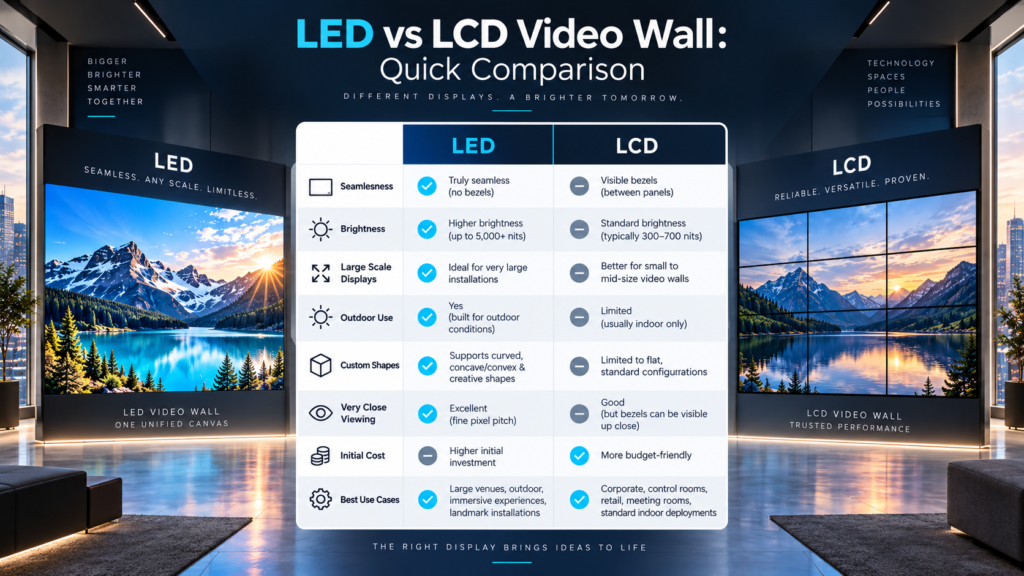
LED vs LCD Video Wall: Quick Comparison
If you need the short answer, this table summarises the most important differences.
| Factor | Direct-View LED Video Wall | LCD Video Wall |
|---|---|---|
| Visible panel seams | Virtually seamless | Visible joins between panels |
| Large-scale displays | Excellent | Good |
| Very close viewing | Excellent with fine pixel pitch | Excellent |
| Pixel density | Depends on pixel pitch and wall size | Generally high |
| Bright environments | Excellent | Good, depending on panel |
| Outdoor installation | Excellent with outdoor-rated LED | Generally not the preferred option |
| Custom dimensions | Excellent | Restricted by panel dimensions |
| Curved/creative displays | Excellent | Limited |
| Small text and dashboards | Excellent at suitable fine pitch | Excellent |
| Full-screen video | Excellent | Good, but bezels may interrupt content |
| Initial investment | Often higher | Often lower |
| Maintenance | Individual modules can often be serviced | Usually panel-level replacement |
| Scalability | Excellent | Good |
| Premium visual impact | Excellent | Good |
| Control rooms | Excellent with fine pitch; application dependent | Strong option |
| Corporate lobby | Excellent | Suitable |
| Retail | Excellent | Suitable |
| Outdoor advertising | Excellent | Not normally the first choice |
The Short Answer
Choose LED when you want a large, bright, seamless or architecturally integrated display.
Choose LCD when close-range detail, conventional screen dimensions and initial cost are more important than creating one completely uninterrupted visual canvas.
Neither technology wins every project.
The better video wall is the one designed around the room, audience, content and operating requirements.
What Is the Difference Between an LED and LCD Video Wall?
Before comparing the two technologies, there is an important terminology issue to clear up.
Many modern LCD displays use LEDs as their backlight.
That does not make an LCD video wall the same technology as a Direct-View LED video wall.
What Is a Direct-View LED Video Wall?
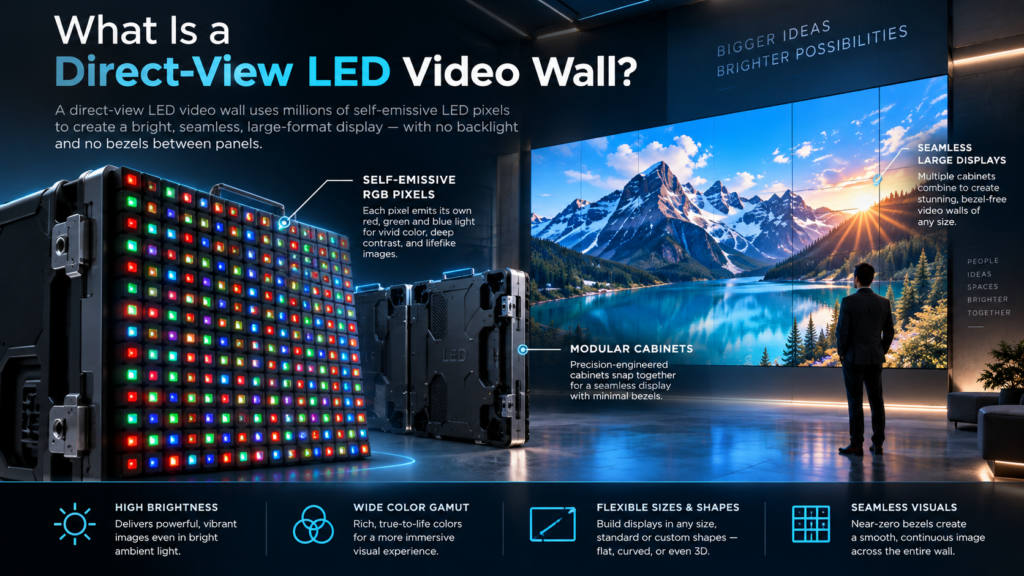
A Direct-View LED video wall—also called DVLED—uses individual light-emitting diodes to create the visible image directly.
Small LED modules are assembled into cabinets, and multiple cabinets are installed together to create a much larger display.
Because there is no conventional LCD panel frame separating each section, a correctly installed Direct-View LED system can produce one continuous visual canvas with no traditional bezel grid interrupting the image.
The modular design also allows LED displays to be manufactured in a wide range of:
- Widths
- Heights
- Aspect ratios
- Pixel pitches
- Resolutions
- Shapes
- Brightness levels
- Indoor and outdoor configurations
This flexibility is one reason LED has become particularly attractive for corporate lobbies, retail environments, shopping centres, showrooms, entertainment venues, control spaces and large public displays.
What Is an LCD Video Wall?
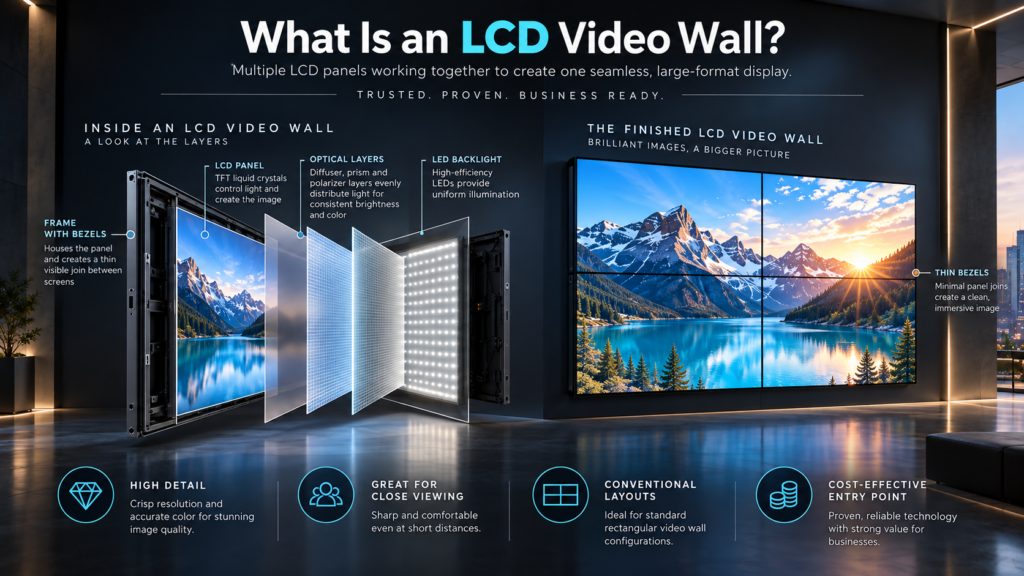
An LCD video wall combines multiple commercial LCD panels into a tiled display.
Each individual panel contains a liquid-crystal layer that controls the image while a backlight illuminates the display.
LCD panels have physical edges or bezels.
Manufacturers have reduced bezel widths dramatically, but when multiple LCD displays are placed together, there is still normally a visible line between neighbouring panels. Samsung and Planar both identify these panel joins as one of the fundamental differences between tiled LCD and Direct-View LED systems.
For many applications, this is perfectly acceptable.
For others—particularly when one large image, human face, architectural visual, advertisement or piece of video content spans the entire wall—the grid can become distracting.
Important: Throughout this guide, “LED video wall” refers to Direct-View LED (DVLED), not an LED-backlit LCD television or commercial monitor.
LED vs LCD: What Are the Biggest Differences?
The difference between LED and LCD becomes much clearer when the technologies are compared against the requirements of a real project.
1. Bezels and Seamless Images
This is one of the strongest advantages of Direct-View LED.
An LCD video wall is made from individual finished displays. Even very narrow-bezel models retain physical boundaries between panels.
If the video wall displays multiple independent feeds—for example CCTV feeds inside a security operations centre—those seams may not significantly affect usability.
But when one image spans several displays, the lines can cross:
- Faces
- Product images
- Logos
- Maps
- Text
- Charts
- Architectural drawings
- Video content
Direct-View LED avoids conventional panel bezels and creates a much more continuous visual surface.
Advantage: LED
2. Resolution
The question “Does LED or LCD have better resolution?” cannot be answered correctly without considering screen size.
LCD panels provide a fixed native resolution.
LED is different.
The total resolution of a Direct-View LED wall is determined primarily by:
Physical Display Size + Pixel Pitch
A useful approximation is:
Horizontal Pixels = Display Width in mm ÷ Pixel Pitch in mm
Vertical Pixels = Display Height in mm ÷ Pixel Pitch in mm
For example, consider a 4-metre-wide LED wall using a 1.5 mm pixel pitch:
4,000 ÷ 1.5 ≈ 2,667 horizontal pixels
That means a 4-metre-wide 1.5 mm LED wall does not automatically provide native 4K width.
To reach approximately 3,840 horizontal pixels at 1.5 mm pitch:
3,840 × 1.5 mm = 5,760 mm
The display would need to be approximately 5.76 metres wide.
This is why specifying an LED wall simply as “4K” without considering physical dimensions and pixel pitch can be misleading.
For LCD, achieving very high pixel density within a smaller physical area is usually straightforward.
For LED, excellent high-resolution results are possible, but the correct pitch and dimensions need to be engineered around the project.
Advantage at small physical sizes: LCD
Advantage for flexible large-scale resolution: Application dependent
What Is Pixel Pitch and Why Does It Matter?
Pixel pitch is the distance between neighbouring LED pixels, usually measured in millimetres.
Examples include:
- 0.9 mm
- 1.2 mm
- 1.5 mm
- 1.8 mm
- 2.5 mm
- 3.9 mm
A smaller pixel pitch places pixels closer together.
That generally provides:
- Greater pixel density
- Better close-range image detail
- Smoother text
- A shorter practical viewing distance
A larger pixel pitch can be perfectly suitable when the audience is farther from the display.
Samsung notes that viewing distance and pixel pitch must be considered together because users positioned too close to a coarse-pitch LED display may begin to distinguish the individual pixels.
This is why automatically choosing the finest—and usually more expensive—pixel pitch is not always a good investment.
AXSS recommends selecting pixel pitch based on:
- Minimum viewing distance
- Typical viewing distance
- Screen dimensions
- Content type
- Required native resolution
- Budget
For a deeper technical explanation, see our Indoor LED Video Wall Buying Guide: Brightness, Resolution, Pixel Pitch & Viewing Distance.
Which Looks Better Up Close: LED or LCD?
Historically, close-range viewing strongly favoured LCD.
Fine-pitch LED technology has reduced that gap significantly.
Modern fine-pitch DVLED systems can support demanding corporate and professional applications where viewers are relatively close to the display. Barco, for example, describes fine-pitch LED solutions suitable for boardroom environments where close viewing matters.
However, specification still matters enormously.
A poorly selected 2.5 mm LED wall viewed from a very short distance can look significantly worse than a suitable LCD display.
A properly designed fine-pitch LED system can produce a completely different result.
For Very Close Viewing
LCD may have an advantage where:
- Screen dimensions are relatively small
- Users sit immediately in front of the display
- Small spreadsheet cells are important
- Fine text is shown continuously
- Extremely high pixel density is required
For Medium to Long Viewing Distances
LED becomes increasingly attractive because the seamless surface and flexible scale become more valuable.
Which Is Better for Text, Data and Dashboards?
This depends on how the content is displayed.
An LCD video wall can be highly effective for:
- Network monitoring
- CCTV
- Operations dashboards
- Financial information
- Data visualisation
- Multiple independent sources
Particularly if content is deliberately positioned so critical information does not cross panel joins.
LED becomes more attractive when:
- One dashboard spans the entire wall
- Maps cross panel boundaries
- Large diagrams need uninterrupted lines
- The same surface alternates between data and full-screen content
- Premium visual presentation matters
Visible LCD seams can make certain line drawings, text or other information harder to interpret when critical content crosses a bezel.
Which Is Better for Video and Advertising?
For full-screen creative content, LED generally has the stronger visual advantage.
A large video, advertisement or branded animation appears as one continuous image rather than an image divided across multiple physical displays.
This is especially useful for:
- Brand films
- Luxury retail
- Product launches
- Automotive showrooms
- Corporate reception areas
- Hospitality
- Entertainment
- Shopping centres
When visual impact is the primary objective, eliminating panel gridlines can significantly improve the finished result.
LED vs LCD Video Wall Brightness
Brightness must be matched to the environment.
A boardroom with controlled lighting has very different requirements from:
- A sunlit retail window
- Shopping centre atrium
- Airport
- Building entrance
- Outdoor façade
- Bright showroom
Direct-View LED is available across a very broad range of brightness levels and is particularly well suited to high-ambient-light environments. Samsung also notes that DVLED is generally capable of handling bright ambient conditions effectively.
LCD can perform very well indoors, especially when lighting conditions are controlled.
Is More Brightness Always Better?
No.
An excessively bright display installed in a dark boardroom can be uncomfortable to view and completely unnecessary.
Brightness should be selected based on:
- Ambient light
- Viewing distance
- Screen location
- Window exposure
- Operating hours
- Content
- Indoor or outdoor use
A well-designed video wall is not the brightest screen available.
It is the screen with the appropriate brightness for its environment.
LED vs LCD Video Wall for Outdoor Use
For outdoor video walls, LED is normally the clear choice.
Purpose-built outdoor LED displays can be engineered for:
- High brightness
- Long viewing distances
- Large physical dimensions
- Weather-resistant installations
- Outdoor advertising
- Stadiums
- Building façades
- Public information systems
Traditional LCD video walls are primarily associated with indoor environments.
Winner for outdoor applications: LED
Screen Size and Custom Dimensions
LCD video walls are based on fixed panel dimensions.
This means the final display dimensions depend on combinations such as:
- 2 × 2
- 3 × 3
- 4 × 2
- 4 × 4
The final aspect ratio therefore depends on the selected panel configuration.
Direct-View LED is much more modular.
LED cabinets can be configured to produce:
- Extra-wide displays
- Very large 16:9 walls
- Tall portrait displays
- Ribbon displays
- Architectural screens
- Columns
- Large custom canvases
Direct-View LED modules can be arranged into dimensions that would be difficult or impossible to achieve cleanly using conventional LCD panels.
Winner for custom dimensions: LED
LED vs LCD for Curved or Creative Video Walls
When a project requires more than a conventional flat rectangle, LED provides significantly more design freedom.
Depending on the selected LED system, projects may include:
- Curves
- Corners
- Columns
- Ultra-wide displays
- Large architectural surfaces
- Custom aspect ratios
LCD remains best suited to conventional flat tiled layouts.
For architects, interior designers, retailers and experience designers trying to make the display part of the architecture rather than simply attach screens to a wall, LED is usually the stronger platform.
LED vs LCD Video Wall Cost
There is no responsible answer to “How much does an LED or LCD video wall cost?” without understanding the project.
Screen area alone is not enough.
Two video walls with exactly the same dimensions can have dramatically different costs because of differences in:
- Pixel pitch
- Resolution
- Brightness
- Cabinet technology
- Mounting system
- Video processing
- Structural work
- Installation access
- Serviceability
- Redundancy
- Content requirements
In many conventional indoor projects, narrow-bezel LCD can provide a lower initial hardware investment than fine-pitch Direct-View LED.
But purchase price is not the same as project cost.
What Should Be Included in a Video Wall Budget?
A professional comparison should consider:
Total Cost of Ownership =
Display hardware
- Video processor/controller
- Mounting structure
- Installation
- Electrical work
- Data infrastructure
- Cooling/ventilation where required
- Maintenance
- Replacement parts
- Calibration
- Energy consumption
- Content systems
- Expected future upgrades
This produces a much more meaningful comparison than simply asking which screen has the lower purchase price.
LED vs LCD: 5-Year and 10-Year Total Cost of Ownership
For permanent commercial installations, evaluate both technologies across the expected operating life of the system.
Ask:
- How many hours per day will the display operate?
- Is the system expected to run 24/7?
- What happens when one component fails?
- Can individual modules be replaced?
- How accessible is the display for servicing?
- Are replacement components expected to remain available?
- Will identical replacement LCD panels still be available several years later?
- How important is visual uniformity after replacing a panel or LED module?
- How much downtime can the business tolerate?
A video wall that is cheaper on day one is not necessarily the lower-cost system over several years.
Maintenance: LED vs LCD Video Wall
Maintenance architecture should be considered before installation.
Maintaining an LED Video Wall
Depending on the product, a technician may be able to access and replace individual LED modules rather than removing an entire large display section.
Front-service designs can also be valuable where there is no practical service corridor behind the wall.
However, correct module replacement, calibration and spare-parts planning are still important.
Maintaining an LCD Video Wall
If one LCD panel fails, the affected panel normally needs to be removed and replaced.
This creates several planning considerations:
- Physical access
- Alignment
- Replacement panel availability
- Colour matching
- Brightness matching
- Calibration
If an LCD panel is replaced after several years of operation, the new panel may need careful calibration to visually match neighbouring displays that have accumulated thousands of operating hours.
Ask This Before Buying Either System
How will a technician access and replace a failed component after the finished wall, cabinetry and interior design are complete?
If there is no good answer, the installation has not been fully designed.
Reliability and 24/7 Operation
Not every LED or LCD product is engineered for the same duty cycle.
For mission-critical environments, specification should consider:
- Operating hours
- Power architecture
- Signal redundancy
- Controller redundancy where required
- Spare modules or panels
- Thermal management
- Monitoring
- Maintenance response
- Component availability
A control room running continuously has different requirements from a retail display operating during store opening hours.
Do not select video wall technology based only on a marketing specification sheet.
Design for the actual operating environment.
Installation Requirements
Whether the project uses LED or LCD, installation quality can determine how professional the final result looks.
Planning should include:
Structural Support
Large commercial video walls can place substantial loads on a wall or mounting structure.
The structure needs to be assessed before installation.
Wall Flatness and Alignment
Small alignment errors can become highly visible across a large display.
Precision matters.
Power
Calculate:
- Required circuits
- Load
- Distribution
- Isolation
- Access for servicing
Data and Signal Distribution
Plan signal paths before walls and joinery are completed.
Ventilation and Heat
Commercial displays generate heat.
Thermal planning may be necessary depending on:
- Display size
- Installation cavity
- Operating hours
- Room temperature
- Ventilation
Video Processing
A video processor may need to handle:
- Scaling
- Multiple sources
- Windowing
- Content switching
- Resolution mapping
- Failover
Service Access
Determine whether equipment can be serviced from:
- Front
- Rear
- Both
For more detail on the process, see our Video Wall Installation Melbourne: From Site Survey to Commissioning guide.
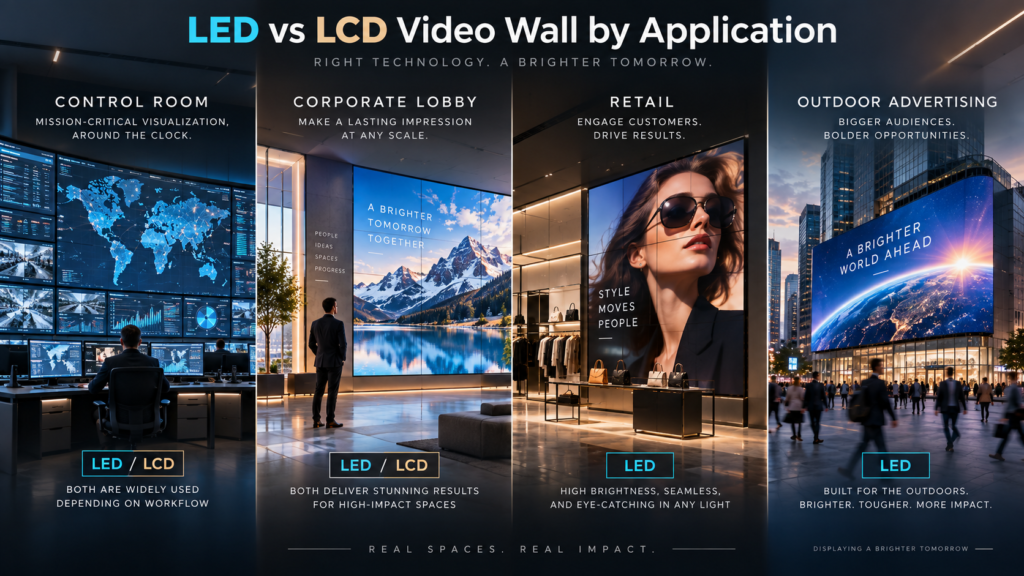
LED vs LCD Video Wall by Application
Technology should follow the application—not the other way around.
| Application | Typical Recommendation | Why |
|---|---|---|
| Corporate lobby | LED | Seamless, premium large-scale presentation |
| Retail flagship store | LED | High visual impact and custom sizing |
| Shopping centre | LED | Scale, brightness and visibility |
| Boardroom | LED or LCD | Depends on viewing distance, size and budget |
| Meeting room | LED or LCD | Depends on required screen size and detail |
| Control room | LED or LCD | Content structure and viewing distance are critical |
| Security operations centre | LED or LCD | Depends on number of sources and bezel tolerance |
| Data dashboards | LCD or fine-pitch LED | High detail required |
| Showroom | LED | Strong full-screen visual presentation |
| University lecture space | LED or LCD | Room dimensions and distance determine choice |
| Hotel lobby | LED | Strong visual impact |
| Entertainment venue | LED | Large format and seamless content |
| Broadcast studio | Fine-pitch LED | Suitable systems can create seamless backgrounds |
| Outdoor advertising | LED | Purpose-built outdoor capability |
| Building façade | LED | Scale, brightness and custom configuration |
These are starting points, not absolute rules.
A site assessment may produce a different recommendation.
Which Is Better for a Corporate Lobby?
For a large corporate lobby, LED is often the strongest solution.
The main reasons are:
- Seamless appearance
- Large physical scale
- Custom dimensions
- Strong brightness
- Premium presentation
- Ability to integrate the screen into architecture
A reception wall often displays:
- Corporate branding
- Brand films
- Announcements
- Welcome messages
- Events
- Live data
- Promotional content
Having a physical bezel cross the centre of a logo or face can reduce the premium appearance of the installation.
Typical choice: LED
Which Is Better for a Control Room?
This is much more application dependent.
LCD video walls remain useful in control environments because operators often work with multiple discrete information windows.
If every camera feed, map or dashboard occupies a defined screen area, panel joins may be less disruptive.
Fine-pitch Direct-View LED becomes more attractive when the organisation wants:
- One continuous information canvas
- Large maps
- Flexible content layouts
- No bezel interruptions
- Premium visualisation
- More freedom in screen dimensions
Do not choose technology for a control room without first mapping the actual information architecture.
Typical choice: LED or LCD depending on workflow
Which Is Better for Retail?
For large retail feature walls, LED often has the advantage.
Retail content typically includes:
- Campaign video
- Product photography
- Lifestyle imagery
- Motion graphics
- Brand storytelling
These formats benefit strongly from a seamless canvas.
Fine-pitch LED can also allow stores to build displays around architectural dimensions rather than forcing the architecture to accommodate fixed television panel sizes.
Typical choice: LED
Which Is Better for a Boardroom?
There is no universal answer.
An LCD solution may be ideal for a smaller room where viewers are close to the screen and budget is a priority.
A fine-pitch LED wall may be preferable where:
- The screen is very large
- A seamless image is important
- The boardroom is a premium executive environment
- Multiple sources need to share one canvas
- The display forms a major architectural feature
Fine-pitch LED has increasingly become viable for boardrooms as pixel pitches have become suitable for closer viewing.
Typical choice: Project dependent
When Should You Choose an LED Video Wall?
Direct-View LED should be high on your shortlist when:
- A seamless image is important.
- The screen needs to be very large.
- You require custom dimensions.
- The room has high ambient light.
- The display is a major architectural feature.
- Full-screen video and imagery are important.
- The display may need to scale in the future.
- You require an outdoor display.
- You need non-standard aspect ratios.
- Visible LCD bezels would compromise the content.
When Should You Choose an LCD Video Wall?
LCD should remain on your shortlist when:
- Viewers sit very close to the display.
- Very high pixel density is important.
- The wall is relatively small.
- The installation follows conventional rectangular dimensions.
- The room has controlled lighting.
- Content is naturally divided into multiple independent windows.
- Some panel seams are acceptable.
- Initial capital expenditure is a major constraint.
For certain projects, LCD is not an outdated compromise.
It is simply the better engineering decision.
LED vs LCD Decision Checklist
Before requesting a quote, answer these questions.
1. How Large Does the Display Need to Be?
Write down the approximate:
- Width
- Height
- Available wall space
Do not specify only diagonal screen size.
2. What Is the Minimum Viewing Distance?
Measure the closest location from which people will normally view the display.
This is particularly important for LED pixel-pitch selection.
3. What Is the Typical Viewing Distance?
Minimum distance is not enough.
Identify where the majority of the audience will actually be.
4. What Content Will You Display?
For example:
- Small text
- CCTV
- Dashboards
- Spreadsheets
- Maps
- Advertising
- Full-screen video
- Photography
- Presentations
- Live television
- Mixed content
5. How Bright Is the Environment?
Consider:
- Windows
- Direct sunlight
- Retail lighting
- Atriums
- Reflections
- Outdoor exposure
6. Is a Seamless Image Essential?
If the answer is yes, LED becomes considerably more attractive.
7. What Resolution Do You Actually Need?
Do not automatically request 4K.
Determine whether native 4K is genuinely required based on:
- Content
- Screen dimensions
- Viewing distance
- Application
8. How Many Hours Per Day Will It Run?
Specify:
- 8 hours
- 12 hours
- 16 hours
- 24/7
9. How Will It Be Serviced?
Determine:
- Front access
- Rear access
- Spare parts
- Acceptable downtime
10. What Is the Actual Project Budget?
Include installation and ownership costs—not just hardware.
Common Video Wall Buying Mistakes
Choosing the Smallest Pixel Pitch Available
Smaller pitch usually increases pixel density, but paying for resolution that viewers cannot perceive at the actual viewing distance may waste budget.
Comparing Screens Only on Price
A quote that excludes processing, structure, electrical work, installation or service requirements is not directly comparable with a complete system price.
Ignoring Content Before Buying Hardware
A screen designed for cinematic brand videos may need different specifications from a wall primarily displaying spreadsheets and dashboards.
Specifying “4K” Without Defining Screen Size
For LED in particular, native resolution is directly related to physical size and pixel pitch.
Ignoring Maintenance Access
A beautiful display that requires dismantling finished joinery every time it needs service is poorly designed.
Choosing Technology Before Conducting a Site Assessment
Screen technology should be the result of the design process—not the starting assumption.
LED vs LCD Video Wall: Which Is Better in 2026?
For most large, seamless, high-impact or architecturally integrated commercial displays, Direct-View LED is increasingly the stronger option.
Its combination of:
- Seamless presentation
- Custom sizing
- Scalability
- High brightness
- Architectural flexibility
makes it particularly attractive for modern retail, corporate, hospitality, entertainment and large-format display environments.
But that does not make LCD obsolete.
LCD remains a practical option for projects requiring:
- High pixel density at shorter distances
- Conventional dimensions
- Controlled indoor environments
- Multiple independent content windows
- Lower initial investment
The correct question is therefore not:
“Is LED better than LCD?”
It is:
“Which display technology produces the best result for this room, this audience, this content and this budget?”
That is the decision a professional video wall design process should answer.
Frequently Asked Questions
Is LED better than LCD for a video wall?
LED is often better for large, seamless, bright or custom-sized video walls. LCD can be a better choice for smaller installations where people view the display from close range, high pixel density is important and visible panel seams are acceptable.
What is the main difference between an LED wall and an LCD video wall?
A Direct-View LED wall creates the image directly using LED pixels arranged across modular cabinets. An LCD video wall combines multiple finished LCD panels. The LCD panels have physical bezels, while a properly installed Direct-View LED wall can create a virtually seamless visual surface.
Does an LED video wall have bezels?
Direct-View LED does not use traditional panel bezels in the same way as tiled LCD displays. LED modules and cabinets are assembled closely together to create a continuous canvas.
Is an LED video wall more expensive than an LCD video wall?
Fine-pitch LED can have a higher initial hardware cost than many narrow-bezel LCD configurations. However, the correct comparison should include installation, processing, servicing, energy, replacement components and expected operating life—not hardware cost alone.
Which is better for close viewing: LED or LCD?
LCD is naturally strong at close viewing distances because of its high pixel density. Fine-pitch Direct-View LED can also provide excellent close-range results, but the pixel pitch needs to be selected carefully based on viewing distance and required resolution.
Which is better for a control room: LED or LCD?
Both can work. LCD is effective for multiple discrete content windows, while Direct-View LED becomes attractive when operators need one continuous canvas without bezel interruptions.
Which is better for a corporate lobby?
Direct-View LED is usually an excellent fit for corporate lobbies because it can create large, seamless displays with custom dimensions and high visual impact.
Can LCD video walls be used outdoors?
Traditional LCD video walls are generally designed for indoor applications. Purpose-built outdoor LED is normally a more suitable technology for large outdoor video walls.
Can an LED video wall display native 4K?
Yes, but an LED wall is not automatically 4K. Its native resolution depends on physical dimensions and pixel pitch. For example, achieving approximately 3,840 horizontal pixels at 1.5 mm pitch requires a display width of roughly 5.76 metres.
What pixel pitch should I choose for an LED video wall?
The correct pixel pitch depends primarily on minimum viewing distance, screen dimensions, content type and required resolution. A finer pitch is normally needed when viewers are closer to the screen. For a detailed explanation, see our Indoor LED Video Wall Buying Guide.
Does LED or LCD use less power?
There is no reliable universal winner. Energy consumption depends on screen area, brightness setting, product design, content, operating schedule and model efficiency. Compare the actual power specifications of the proposed systems rather than assuming one technology always uses less electricity.
How do I decide between LED and LCD?
Start with five factors:
- Screen dimensions
- Viewing distance
- Content type
- Ambient light
- Total project budget
Then evaluate resolution, pixel pitch, seamlessness, installation access and long-term maintenance requirements.
Need Help Choosing Between an LED and LCD Video Wall?
Choosing a video wall should begin with the space—not a product catalogue.
AXSS can assess your:
- Available wall dimensions
- Minimum and typical viewing distances
- Ambient lighting
- Content
- Resolution requirements
- Pixel pitch requirements
- Mounting conditions
- Service access
- Video processing requirements
- Indoor or outdoor environment
- Project budget
before recommending the most appropriate display technology.
Whether the right solution is a fine-pitch Direct-View LED wall, an LCD video wall or another commercial display configuration, the objective should be the same:
Create a display that looks right from the audience’s actual viewing position, performs reliably in the real environment and remains practical to operate and maintain over its working life.
Planning a video wall project in Australia? Talk to AXSS about your screen dimensions, viewing distance and application to determine the right solution before you invest.
CTA: Request a Video Wall Consultation
Secondary CTA: Get a Video Wall Quote