Outdoor Digital Signage Sydney: The Complete Guide for Businesses
Stand outside a west-facing shopfront in Chatswood at four in the afternoon. If the café reflected in the glass is easier to see than the price on the screen, a bigger panel won’t solve the problem. Of all the outdoor digital signage Sydney retailers can choose, a high-brightness window display may suit that spot. Move it a metre outside the glass and the specification changes.
Before asking for prices, answer three questions. Where will people read the sign? What must they be able to read? Who controls that space?
What Is Outdoor Digital Signage?
Outdoor digital signage is an electronic display that presents information to people outside. It might show the lunch menu at a takeaway, the entry gate for a sports ground or a retailer’s campaign to people walking past a shop window.
The display produces the image, a media player runs it, and a content management system (CMS) lets staff schedule changes. The player may be built into the screen. Ask to see how someone on a Friday lunch shift would correct a price and confirm the change appeared.
Buying a screen for your premises also means taking responsibility for its upkeep. If the aim is to advertise elsewhere in Sydney, booking airtime on an existing billboard is a separate purchase.
Types of Outdoor Digital Signage in Sydney
Choose the format by viewing distance, exposure and the time someone has to read. A person ordering from a parked car can compare several prices. Someone looking across a playing field needs a large, recognisable message.
Digital Billboards (LED)
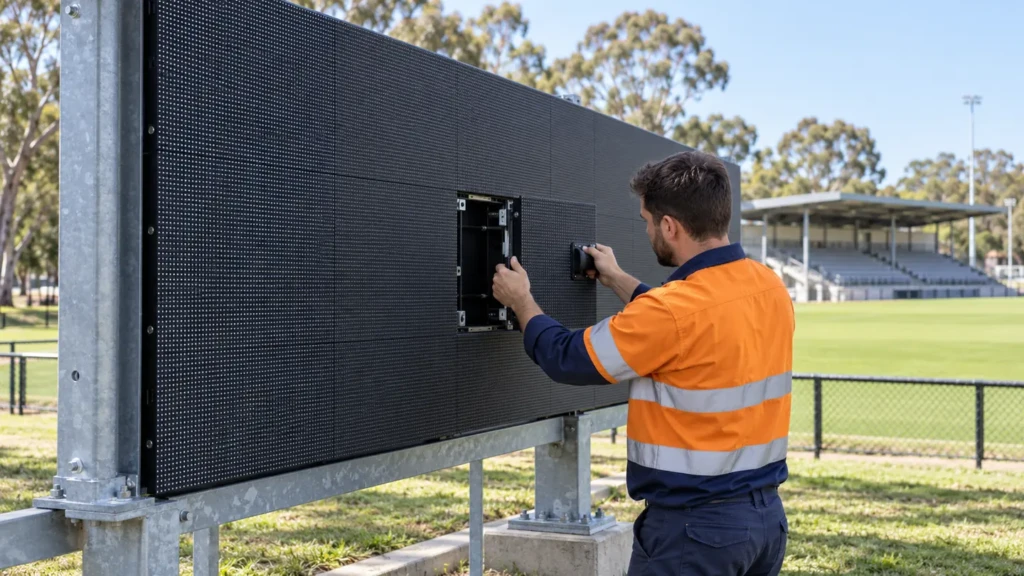
A direct-view outdoor LED display builds its picture from light-emitting pixels arranged in modules. The modules can form a wide scoreboard, a building sign or a roadside billboard. Pixel pitch is the distance between neighbouring pixel centres. A smaller pitch packs more detail into the same area, which matters when the audience is close enough to see it.
For a digital billboard in Sydney, ask two different questions. A media owner can tell an advertiser how often a campaign will appear and provide proof of play. An installer can tell a property owner how the structure will be supported, which modules can be serviced from the front and whether the proposed site is feasible.
Free-Standing Totems and Kiosks
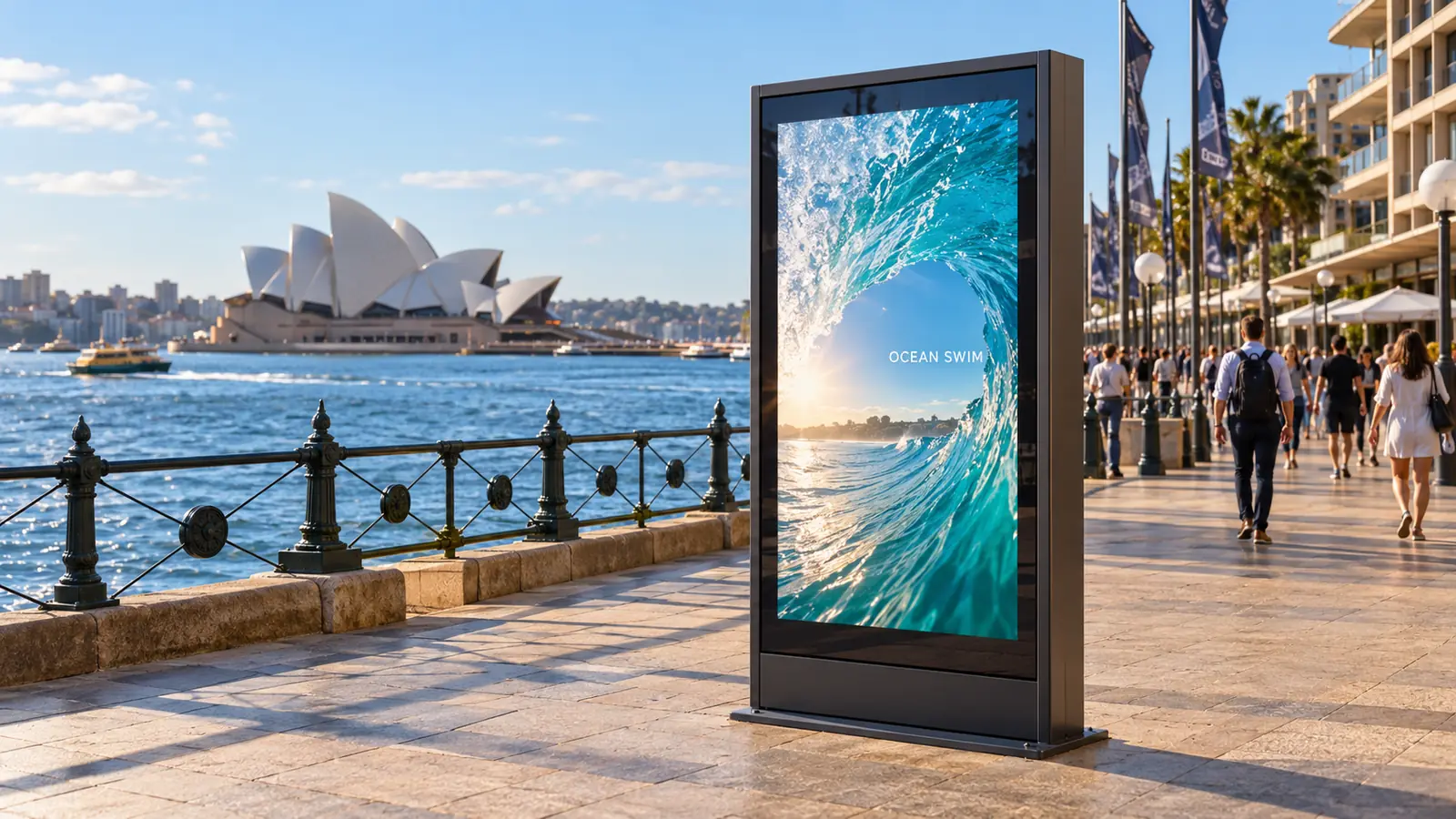
A digital totem puts a portrait display where there is no suitable wall. It can show a directory at a Liverpool medical precinct or guide visitors from a car park to reception. A touch kiosk makes sense when visitors need to search a directory, choose a language or find an accessible route.
Mark the totem’s footprint on the ground. Walk past it with a pram, approach from seated eye level and mark out the swing of the service door. Will people still be able to enter when a technician opens it?
Window-Facing High-Brightness Displays
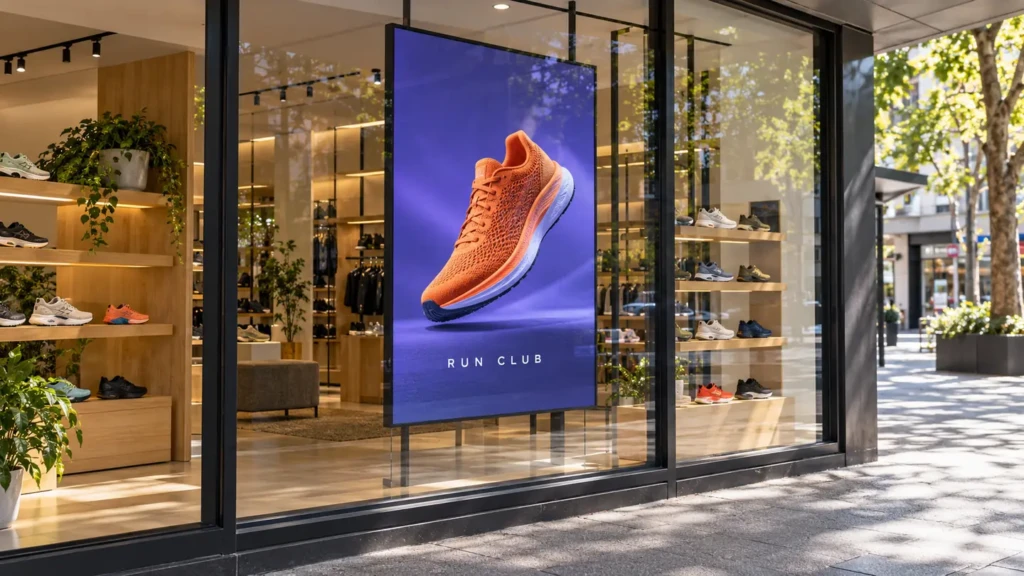
A window-facing display sits inside and faces the street. It suits a Chatswood retailer changing promotions or an estate agency showing listings after closing. Check the image through the actual glass. Tint, reflections from buildings opposite and the angle of the afternoon sun can make a showroom demonstration misleading.
Follow the mounting clearances for sunlit glazing. Samsung’s 3,000-nit OM55B, for instance, is designed for shop windows. Moving it outside would change its exposure to rain and dust.
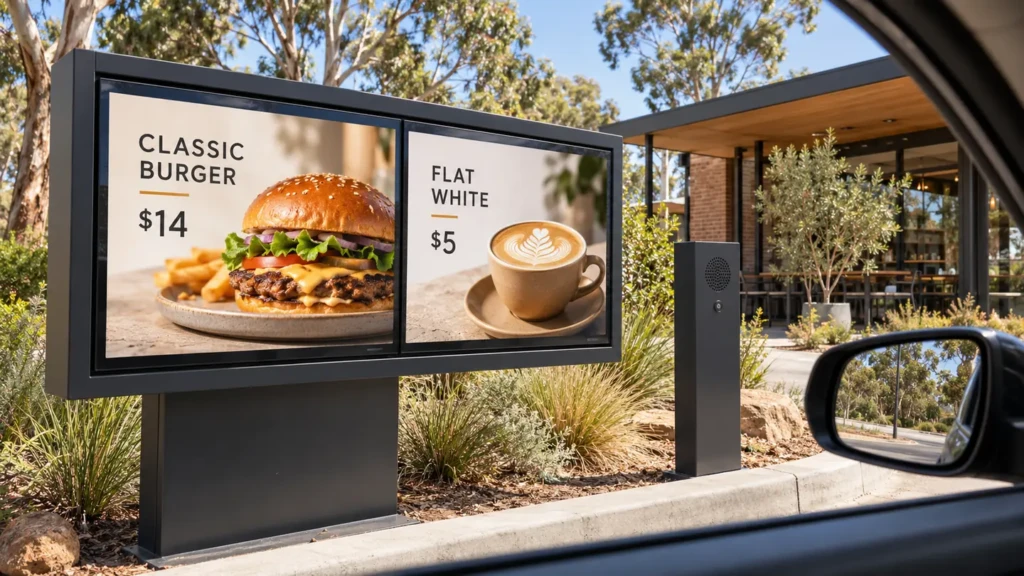
Digital Menu Boards and Drive-Through Screens
An outdoor digital menu board lets a restaurant switch from breakfast to lunch, correct a price or remove an unavailable item. Design the menu at the size a driver or pedestrian will actually see. A bestselling meal, its price and the available sizes should fit on one screen long enough for someone to order.
At a drive-through, test from the driver’s seat of a small car as well as a taller vehicle. Check sightlines around the speaker, the turning angle into the lane and glare on the price column. Give staff a way to remove a sold-out item without waiting for head office to redesign the menu.
Transit and Street Furniture Screens
Bus shelter panels reach pedestrians and waiting passengers, but the right to sell advertising belongs to the operator managing that inventory. The City of Sydney identifies QMS as its street furniture operator. A business seeking exposure on those panels can start with a media brief listing preferred locations, dates and budget.
Outdoor Digital Signage Sydney – Key Features to Look For
Specify what you can test at the premises. A useful acceptance test covers legibility in sun, dimming after dusk, weather protection and recovery after a fault.
Brightness (Nits) for Australian Sunlight
A nit is one candela per square metre, a measure of luminance. Compare typical brightness with typical brightness. Samsung’s OHDX outdoor LCD, for example, lists 3,500 nits and a peak of 4,000. The peak figure alone tells you little about whether a customer can read grey prices on a pale background through reflective glass.
Take your own artwork to the demonstration. Read the smallest important line from the intended distance, then inspect the screen after dark. Ask the installer to show how automatic dimming works and who can adjust the maximum brightness to the level permitted for your site.
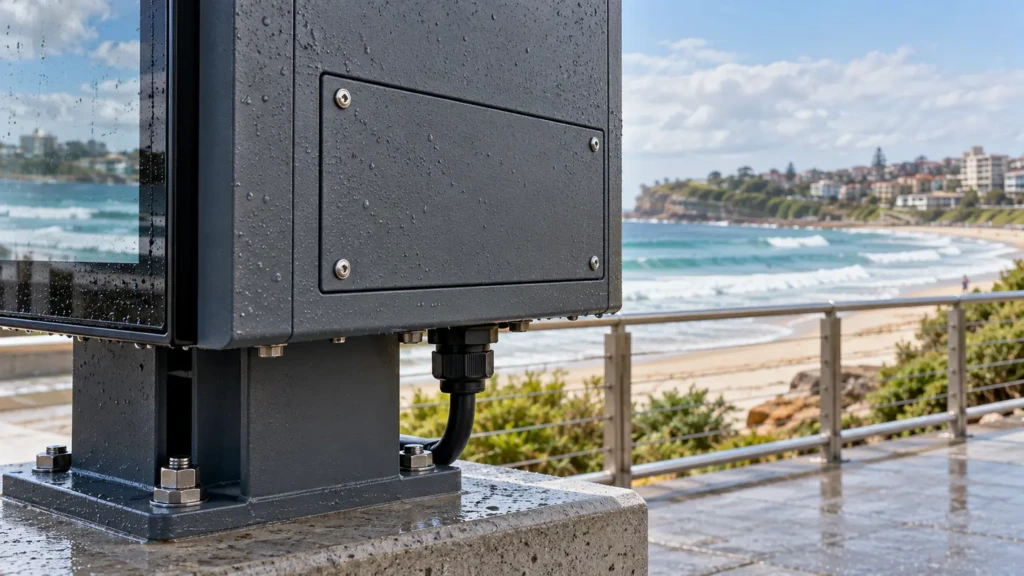
Weatherproofing (IP65/IP66) and Coastal Humidity Resistance
IP65 and IP66 both describe dust-tight enclosures. IP65 covers water jets, while IP66 covers more powerful jets under test conditions. When comparing weatherproof digital signage, check which faces are rated. Wind-driven rain can reach the rear, cable entries and connection box.
At a Bondi site exposed to salt spray, ask for written confirmation that the cabinet finish, fasteners and connectors suit the location. An IP rating alone does not establish salt-corrosion resistance. Check the permitted humidity range, how the enclosure manages condensation and any cleaning obligations attached to coastal warranty cover.
Temperature Control and Cooling
A west-facing window in Penrith can trap heat between the screen and the glass. Give the supplier the orientation, operating hours and depth of that gap. Ask for the model’s operating temperature range in the proposed mounting position and what it does when it reaches its thermal limit.
Have the installer show how a technician will reach the fan or filter. If that means dismantling the shopfront, get that labour priced before signing.
Anti-Glare and Vandal-Resistant Glass
Anti-glare treatment helps control reflections. Impact protection addresses a different problem. For a street-level outdoor LCD screen, ask for the impact rating of the exposed face, the price of replacement glass and whether the technician can replace it independently of the panel.
View the sample from both directions of approach, including through polarised sunglasses. If the image darkens or disappears from a common viewing angle, change the model or mounting orientation before the glazing and brackets are ordered.
Remote Content Management (CMS)
A CMS should let the right person change one screen without affecting every location. Ask a supplier to demonstrate a Parramatta-only price change, the automatic expiry of a weekend offer and the screen’s behaviour when the internet drops out.
Give local managers control of availability and head office control of brand templates. Check what “online” means in the dashboard. Can it tell you the display has gone dark even if the player is still connected?
Outdoor Digital Signage Cost in Sydney
Australian retail examples put 43–55-inch IP66 outdoor LCD hardware at AUD $5,665–$7,945 including GST. A published benchmark for a small, installed 3 m² outdoor LED project is AUD $15,000–$35,000, with GST treatment to confirm. These are different purchases, so compare the scope of each figure.
Hardware Costs
These published examples provide a starting budget for Sydney buyers. As with any estimate, prices are indicative and vary by project.
| Item | Price range (AUD) | What the figure covers |
|---|---|---|
| High-brightness window display, 43–55 inches | $2,675–$3,865 incl. GST | Display hardware for use behind glass. |
| Slim IP66 outdoor LCD, 43–55 inches | $5,665–$7,945 incl. GST | Wall-mounted model range, before installation. |
| Freestanding LED monolith | $12,000–$17,150 excl. GST | Selected packages with structure, controls, spares and first-year CMS. Freight and installation extra. |
| Small outdoor LED project, 3 m² | $15,000–$35,000 | Installed benchmark including rigging. Confirm GST. |
| Basic mounting labour | $200–$500 per screen | General commercial mounting benchmark. Confirm GST and outdoor access costs. |
| CMS and support plans | $10–$49 excl. GST per screen/month | Entry to managed plans. Check device requirements and minimum term. |
| Routine annual hardware service | $300–$600 per site | General commercial benchmark. Confirm GST, parts and access equipment. |
Installation Costs
A basic wall-mount allowance is a poor guide to the cost of a freestanding sign. A totem may need excavation, a concrete footing, a new power run and reinstatement of paving. A façade installation may need a lift and access outside trading hours. Ask who pays if the crew arrives and the agreed loading space is unavailable.
Software and Maintenance
Compare each quote over the same ownership period. At AUD $25 per screen per month excluding GST, five years of software for three screens comes to AUD $4,500 excluding GST, assuming an unchanged rate. Add power, connectivity, cleaning, call-outs and any lift hire. Check which subscriptions are already included in the hardware price.
Want a figure for your own premises? Send AXSS a site photo and approximate dimensions and ask for hardware, installation and recurring fees on separate lines.
Council Approvals and Regulations in Sydney
Check the approval pathway for the exact address before ordering. Chapter 3 of the NSW State Environmental Planning Policy (Industry and Employment) 2021 sets the statewide framework. Local controls, heritage status and existing consents also matter. Planning
Development Applications (DA) and Council Permits
Some business signs qualify as exempt development only when they meet the general and sign-specific standards. The NSW Planning Portal calls for written owner consent under the exempt pathway and identifies separate approval where a sign projects over a public road or footpath. Ask council whether your proposal qualifies or needs a development application.
Send a marked-up photo with dimensions, height, hours and sample content. Say whether you will identify your own premises or carry third-party advertising. For a replacement, attach any approval for the existing sign and describe the change from print to electronic content. That gives the planner a specific proposal to assess.
NSW Lighting and Road Safety Rules
For digital advertising assessed under the NSW transport corridor guidelines, the specified minimum dwell time for a static image is 10 seconds below 80 km/h and 25 seconds at 80 km/h or above. The guidelines also address luminance, transitions and driver distraction. Roadside criteria apply in their defined context. Ask which requirements and consent conditions govern your particular sign.
Have the installer record the approved settings at handover. Give marketing staff permission to change an offer while keeping animation, dwell time and night-time brightness locked to approved settings.
Differences Between Councils
North Sydney Council lists video and variable-message signs among prohibited advertisements. For a site in its area, establish how council classifies your proposal before commissioning artwork. In the City of Sydney, a signage application for a heritage item or a site in a heritage conservation area can require a signage strategy and heritage impact statement.
Best Locations and Use Cases in Sydney
Place the display where someone can still act on the message. A directory belongs before the paths divide. A lunch offer belongs where pedestrians have time to read the price and turn into the shop.
| Sydney setting | Useful job for the display | What to test on site |
|---|---|---|
| Parramatta lunch precinct | Show today’s takeaway special and collection point | Read the price from the back of the queue |
| Chatswood shopfront | Present a small selection of products through glass | Test afternoon reflections with the shop lights on |
| Bondi beachfront business | Show class times or availability at the entrance | Check salt exposure, glare and cleaning access |
| Liverpool medical precinct | Direct arrivals to the right building | Read directions from a wheelchair before the path forks |
| Penrith sporting ground | Show match details and gate changes | Read team names from the farthest intended viewing point |
Benefits of Outdoor Digital Signage vs Static Signs
Digital earns its keep when information changes often or goes stale quickly. Static signs suit permanent directions, building names and messages that need to remain visible through a power outage. Many sites benefit from both.
Consider a venue that hosts sport on Saturdays and markets on Sundays. Fixed lettering can identify the venue all week. A screen at the entrance can show which gate is open that morning. If a visitor arrives while another slide is playing, the gate number should still be visible.
For a retailer, build the business case from the last year’s print invoices, freight and staff time spent changing signs. Compare that total with the annual cost of the screen. Track one outcome after launch, such as orders of the featured lunch special on comparable trading days.
How to Choose the Right Supplier in Sydney
Choose a supplier that will inspect the site, demonstrate your content and name the people responsible for installation and support. For commercial digital signage in Sydney, ask for a reference from a site with similar conditions.
- Comparable work. Ask to see a coastal unit, glazed shopfront or roadside installation with similar exposure to yours.
- Specified hardware. Get the model, dimensions, brightness, environmental rating and the side used for service access.
- Approval responsibilities. Establish who prepares drawings, who lodges any application and who pays the fees.
- Installation scope. Identify the party responsible for the structure, electricity, data, access equipment and making good.
- Local support. Request attendance times for your postcode and distinguish a phone response from a technician arriving.
- Warranty and ownership. Confirm parts, labour, freight, coastal exclusions, CMS access and what you can export if you change providers.
Installation Process: Step by Step
Start with a site survey and finish with a staff member independently publishing a change. Agree on the acceptance tests before work begins so both parties know what a completed installation looks like.
- Survey the site. Record orientation, viewing distances, power, network coverage, fixings and maintenance access. Photograph the location when glare is worst.
- Mock up the sign. Mark its outline at full size. Test real prices, directions or artwork from the customer’s position.
- Confirm permissions and design. Obtain required consents, establish any engineering requirements and approve an itemised quote before fabrication.
- Prepare and install. Coordinate access with the landlord and trades. Engage a licensed electrician for wiring work.
- Commission in daylight and after dark. Test dimming, scheduling, network loss and restart after power returns. Check the displayed content against any consent conditions.
- Hand over and train. Collect drawings, serial numbers, warranty terms, maintenance instructions and administrator access. Ask your team to publish, verify and then remove a test offer.
Outdoor Digital Signage Sydney – Frequently Asked Questions
A sunny shopfront, an exposed menu board and a roadside billboard each need a different specification. Use your viewing distance, weather exposure and approved use to narrow the choice.
Can I put a normal TV in my shop window?
A consumer TV may be hard to read through glass and its warranty may exclude commercial use. Check afternoon reflections, operating hours and the temperature behind the pane. For a sunny shopfront, compare a purpose-built high-brightness display using your own artwork at the actual viewing distance.
Do I need council approval for a screen inside the glass?
Check with the council responsible for your address before installing a street-facing screen. Provide its dimensions, position, operating hours and an example of what it will show. A location behind glass does not settle the planning question, particularly for illuminated advertising or a building with heritage controls.
Should I choose LED or LCD for an outdoor menu?
Choose an outdoor-rated LCD when customers stand close enough to compare prices, ingredients and meal sizes. Consider direct-view LED for a larger display read across a forecourt. Ask both suppliers to show the same menu at full size and judge it from the actual ordering position.
What happens when the internet connection drops out?
A player with local storage can continue showing previously downloaded material if the CMS supports offline playback. Live prices, availability feeds or remote updates may stop refreshing. Disconnect the network during commissioning, watch what customers see, then reconnect it and check that the correct scheduled content resumes.
Can I advertise on an existing Sydney billboard?
Yes. Ask the media owner or its sales representative for available locations, campaign dates, artwork specifications and how often your advert will appear. The quoted fee buys airtime. Ask for proof of play after the campaign and check whether artwork production is included in your booking.
Get a Free Quote in Sydney
For a quote on outdoor digital signage Sydney customers can read from the pavement, car or queue, send Axeleron Screen Solutions (AXSS) your suburb, approximate dimensions, a photo from the viewer’s position and a sample of your content. Mention when glare is worst.
AXSS provides custom signage, installation, remote content management and maintenance for Sydney projects. Ask how its advertised three-year warranty applies to parts, labour and on-site attendance for your display. AXELERON
Call 1300 600 003 or request a free Sydney signage quote.